Training-only, report-only and campaign-style lean programs fail because they treat a habit problem as a knowledge problem. RCG's path: assess the baseline, map the value stream, coach on the floor...
A value stream map is the X-ray of lean improvement: pick a product family, go to the floor, seven steps to map material and information flow — most factories find their value-added ratio is under 5%...
Companies spend real budgets sending managers to lean training courses, yet the factory goes unchanged. The problem is not the course — it is the learning method: knowledge transfers in classrooms, capability is built on the floor...
Footwear is a high-mix, low-volume, labor-intensive industry: shorter lead times, more frequent style changes, scarcer skilled labor. The three lean priorities for footwear factories: changeover speed, flow takt and WIP, built-in quality...
Year after year of price pressure usually buys you corner-cutting, not savings. Sustainable cost and quality are developed, not squeezed — the three-party model of supplier lean development and the H&M supply chain case...
When introducing lean, the business owner’s biggest concern is whether lean can make the company money. This urgency is understandable, since every business investment expects a return. So lean must be a down-to-earth path of practice, not a war of empty words. Balancing short-term gains and long-term capability is a matter of strategic deployment throughout a lean rollout: a good strategy succeeds and a bad one fails. Some companies introducing lean may have been swayed by certain consulting firms’ so-called “high-end” pitches: from organizational change to Industry 4.0, everything sounds wonderful, but it all lives in the imagination, while quality problems and low efficiency on the shop floor remain unsolved. The biggest danger in implementing lean is doing long-term things too early while disdaining the near-term tasks, which is why many companies’ collaborations with consulting firms fail.
Success takes patience, but it also takes speed. When lean is treated as a method and tool, it must quickly bring benefits to the company, improving quality, efficiency and cost. When lean is treated as a philosophy, it reshapes the company’s DNA: changing how things are done develops people, and developing people changes more things, forming a virtuous cycle.
Finally, talking only about philosophy without results is empty, and chasing only results without philosophy is short-sighted and unsustainable. Only by finding a way that balances your company’s short- and long-term needs can lean take root in your business.

The front-line production workshop is the most critical place for a manufacturer. Front-line employees directly affect production progress and product quality, so creating a good workshop environment is an important mark of an excellent manufacturer. Outside northern China, most of the country, especially the manufacturing-heavy south, sees temperatures close to or above 35°C. Cooling the production environment is a pressing and practical issue!

Without a reasonably comfortable working environment, productivity drops at best and workers fall ill at worst. A factory without a good environment is clearly unattractive to workers, which leads to hiring difficulties and high turnover. In addition, much production equipment develops all kinds of problems when it runs in high heat for long periods. The production environment deserves real attention.
Below are several methods for your reference; the best one is the one that fits your company. With summer heat lasting several months, it demands close attention, so plan or improve early:
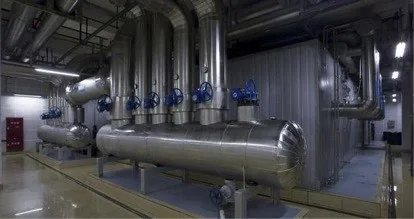
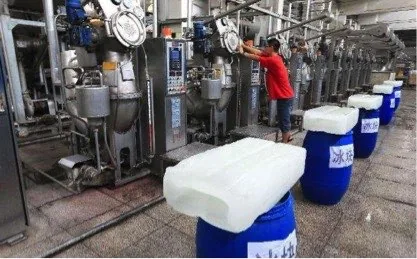
Ice cooling uses the heat absorbed as ice melts to lower air temperature. Because air conducts heat poorly, the cooled area is small, and using it over a large area inevitably runs into high costs.
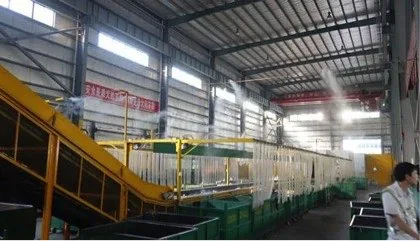
Mist cooling is also an effective method, but the excess humidity affects machinery and people’s health, so it is not suitable for production workshops. It is a compromise-type cooling method.
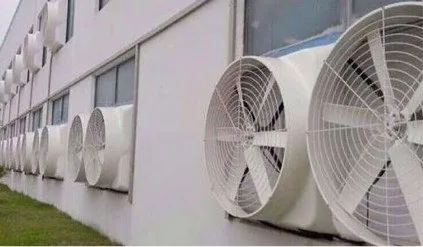
Negative-pressure fans work on air convection and negative-pressure ventilation: fresh air is drawn in naturally through the opposite door or window of the installation point, and the stuffy indoor air is forcibly expelled outdoors. The drawback of negative-pressure fans is noise, which is hard to solve.
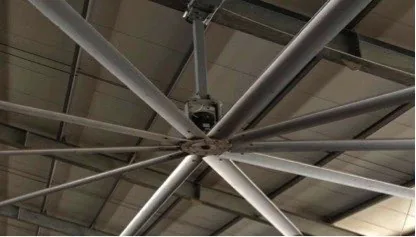
This method can be said to be one of the better options in terms of cost-effectiveness. Unlike traditional desk fans and wall fans, which have many drawbacks, large industrial ceiling fans let most manufacturers ventilate the whole plant. In summer they can quickly lower employees’ perceived temperature by 5–8°C and significantly raise productivity.